Truck driver pay is one of the most searched topics in trucking, and one of the least precisely answered. The question "how much do truck drivers make" depends on who is counted, how the driver is paid, and what costs come out of the number. This guide uses the U.S. Bureau of Labor Statistics (BLS) for the headline figures, explains the pay methods BLS describes, and covers the federal lease rules that protect owner-operators' compensation. It does not offer a salary for your situation, because no national figure can. Truck driver compensation covers more than the headline number, so the sections below separate the federal data from the pay methods and the owner-operator lease rules.
What the Federal Data Shows
The BLS Occupational Outlook Handbook covers heavy and tractor-trailer truck drivers. Its latest figures, published in the handbook page last modified on 27 August 2026, are:
| Measure | Figure |
|---|---|
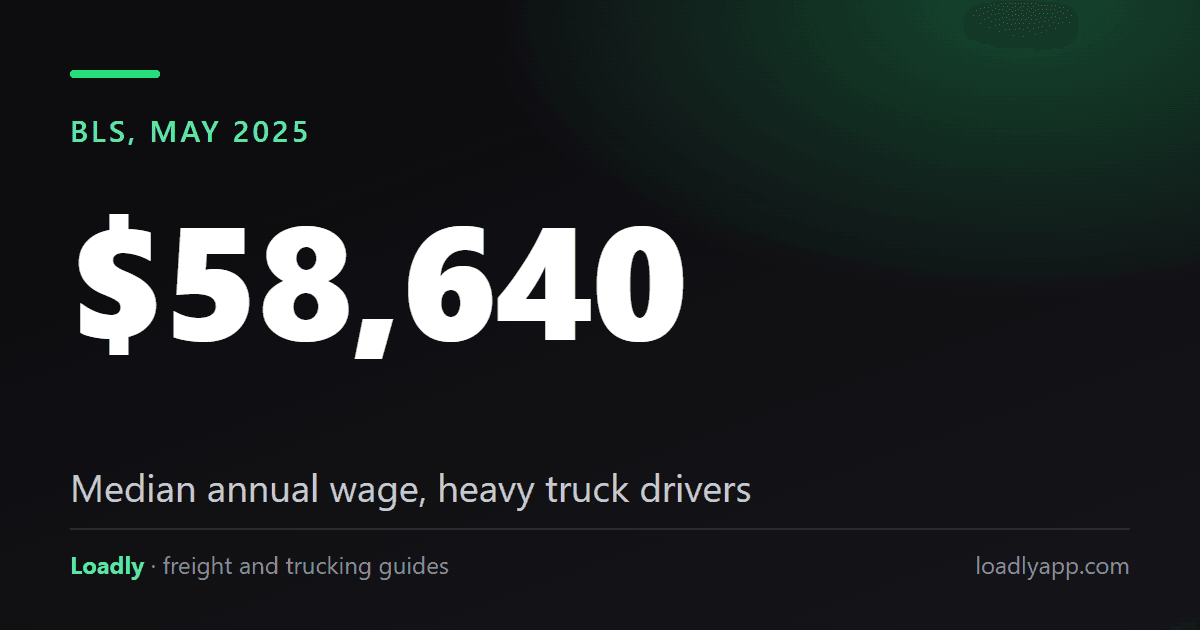
| Median annual wage, May 2025 | $58,640 |
| Median hourly equivalent | $28.19 |
| Lowest 10 percent earned less than | $40,140 |
| Highest 10 percent earned more than | $79,380 |
| Jobs, 2025 | 2,221,200 |
| Projected growth, 2025 to 2035 | 4 percent (83,800 jobs), as fast as average |
| Typical entry-level education | Postsecondary nondegree award |
BLS also lists median annual wages by industry for May 2025: $60,320 in truck transportation, $58,550 in wholesale trade, $56,570 in manufacturing and $56,080 in construction. The hourly equivalent is simply the annual median converted to an hourly rate. It is consistent with dividing by a 2,080-hour year ($58,640 ÷ 2,080 is about $28.19). It does not mean most drivers are paid by the hour.
Two cautions apply to these numbers. First, they describe wages for employees in the occupation, not the take-home of an owner-operator who pays their own fuel, insurance and maintenance. Second, a median is the middle of the distribution; half of drivers earn less and half more, and the gap between the 10th and 90th percentiles here is about $39,000 a year.
How Drivers Are Paid
BLS describes the usual arrangement in plain terms: drivers of heavy trucks and tractor-trailers usually are paid by the number of miles they have driven, plus bonuses. The per-mile rate varies from employer to employer and may depend on the type of cargo and the driver's experience. BLS adds that some long-distance drivers, especially owner-operators, are paid a share of the revenue from shipping.
With mileage pay, earnings track paid miles, not hours worked. Time spent waiting to load or unload, or stuck in traffic, usually produces no mileage. The hours-of-service rules limit how many hours a driver may drive, so paid miles per week are capped by regulation as well as by freight availability. See Hours of Service for Truck Drivers: The Limits and Their Exceptions for those limits.
Mileage Pay and Revenue Share, in Numbers
These use made-up round numbers to show the arithmetic. They are not market rates.
- Mileage pay. A company driver paid $0.60 per mile who is paid for 2,500 miles in a week earns 2,500 × $0.60 = $1,500 for the week before deductions. The same driver paid for 2,000 miles earns $1,200. The rate did not change; the paid miles did.
- Revenue share. An owner-operator whose lease pays 80 percent of the gross revenue on a $3,000 load receives 0.80 × $3,000 = $2,400 from the carrier. Fuel, insurance, equipment payments and maintenance are paid out of that amount, which is why a share of revenue cannot be compared directly with a wage.
Federal Rules That Protect Owner-Operator Pay
When an owner-operator leases equipment and driving services to an authorized carrier, 49 CFR 376.12 sets what the written lease must say. The parts that bear on pay include:
- Compensation specified (376.12(d)). The amount to be paid by the authorized carrier for the equipment and driver's services must be clearly stated on the face of the lease or an attached addendum. It must be delivered before the first trip. It may be a percentage of gross revenue, a flat rate per mile, a variable rate by direction or commodity, or another agreed method.
- Payment period (376.12(f)). The lease must provide that payment is made within 15 days after submission of the necessary delivery documents for a trip. The documents the carrier can require are limited to the driver's logbooks required by the Department of Transportation and the documents needed to secure payment from the shipper.
- Freight bill copies (376.12(g)). The lessor must be able to examine copies of the freight bill or equivalent documentation, and the carrier's tariff or other documents from which rates and charges are computed.
- Charge-backs (376.12(h)). The lease must list every item that may be advanced by the carrier and later deducted from compensation. It must explain how each amount is computed. It must also give the lessor copies of the documents needed to check the charge. The carrier must provide a written explanation and itemization of any cargo or property damage deductions before making them (376.12(j)).
- Escrow funds (376.12(k)). If escrow is required, the lease must state the amount and what it can be applied to. It must say how the carrier will account for it, and that the carrier pays interest on it at least quarterly.
Overtime for Drivers
Whether a driver is owed overtime under the Fair Labor Standards Act is a legal question that turns on facts. The federal regulation at 29 CFR 782.2 explains that the section 13(b)(1) exemption from the Act's hours provisions depends on two things. One is the employer's class: carriers whose transportation by motor vehicle is subject to the Secretary of Transportation's jurisdiction. The other is the class of work the employee performs: activities directly affecting the safety of operation of motor vehicles in interstate or foreign commerce, defined in terms of drivers, driver's helpers, loaders and mechanics. It also notes that whether an individual employee falls within the exemption is decided by judicial process. A driver with a question about overtime should read the full regulation or ask the U.S. Department of Labor or an employment lawyer.
BLS does not break these figures out by carrier, region or lane. Light-truck and delivery drivers are a separate BLS occupation, and tax treatment, per diem and the full cost of running a truck as an owner-operator are outside this guide.
Frequently Asked Questions
What is the average truck driver salary?
BLS reports a median annual wage of $58,640 for heavy and tractor-trailer truck drivers in May 2025. It is a median, not an average, and it covers employees; the lowest tenth earned under $40,140 and the highest tenth over $79,380.
Are truck drivers paid by the hour or by the mile?
BLS says heavy truck and tractor-trailer drivers usually are paid by the miles driven, plus bonuses. Some are paid by other methods, and the hourly figure BLS publishes is only a conversion of the annual median.
How fast must an owner-operator be paid?
Under 49 CFR 376.12(f), a lease must provide that payment is made within 15 days after the necessary delivery documents for a trip are submitted.
Can a carrier deduct charge-backs from an owner-operator?
Only for items the lease specifies, with an explanation of how each is calculated, and with copies of the documents needed to verify the charge. Deductions for cargo or property damage require a written explanation and itemization before they are made.
How much do CDL truck drivers make?
The federal figure used in this article covers heavy and tractor-trailer truck drivers: a median annual wage of $58,640 in May 2025. Drivers in other occupations that also use a CDL are counted separately, and this article does not cover them.
Sources
Wage figures: BLS Occupational Outlook Handbook, page last modified 27 August 2026. Regulation text: eCFR, 7 October 2026.