A load board (some sites call it a truck board or freight board) is an online listing service where freight is posted and carriers look for loads. People search for "load boards," "free load boards," "load board for truckers," "box truck load boards" and "load boards for cargo vans" to find work. This guide does not rank boards or recommend one, because features and prices change and none of the primary sources used here publish comparisons. It covers something that does not change as fast: how the federal rules apply to the people posting on a board, and what a carrier should verify before booking a load.
Who Is Posting?
Freight on a board is posted by shippers, by brokers, and by carriers looking to move a load on to another carrier. The legal category matters, because the rules differ:
- A broker arranges transportation by a motor carrier for compensation and is not itself a carrier (49 U.S.C. 13102(2)). It must be registered (49 U.S.C. 13901, 13904) and hold a $75,000 bond or trust fund (49 CFR 387.307).
- A motor carrier provides motor vehicle transportation for compensation and must be registered to operate subject to the Act (49 U.S.C. 13102(14), 13901).
- A shipper tendering its own goods is generally neither a broker nor a for-hire carrier. A shipper can fall into one of those categories if it also arranges transportation for others, or moves goods with its own trucks.
The statute defines a broker by what it does, including holding itself out by solicitation or advertisement as arranging transportation. Whether a particular posting service is a broker depends on what it actually does, which is a fact-specific question this article does not decide. Operators of the board itself may or may not be brokers.
Checking a Load Before You Book
| Check | Why, and what the rule says |
|---|---|
| The poster's registration | A person may act as a broker or motor carrier subject to the Act only if registered (49 U.S.C. 13901). Confirm the registration on FMCSA's Licensing and Insurance website by entering the MC or USDOT number. |
| Bond or trust fund for a broker | A broker's registration remains in effect only as long as its $75,000 security does (49 CFR 387.307). See Freight Broker Bond and Trust Fund Rules, Explained. |
| Name on the rate confirmation | A broker may not operate in a name other than the one on its registration, and may not represent itself as a carrier (49 CFR 371.7). |
| Transaction records | A broker must keep a record of each transaction for three years, and each party to a brokered transaction has the right to review it (49 CFR 371.3). |
| Your own limits | Whether you can legally run the load: hours of service, axle and gross weight, cargo securement. See the guides linked below. |
| Claims terms | Filing periods cannot be shorter than nine months and suit periods two years from written disallowance (49 U.S.C. 14706(e)). |
If you are checking a company more generally, How to Check a Trucking Company Before You Hire It covers insurance and safety ratings.
Reading the Rate: Loaded Miles vs Total Miles
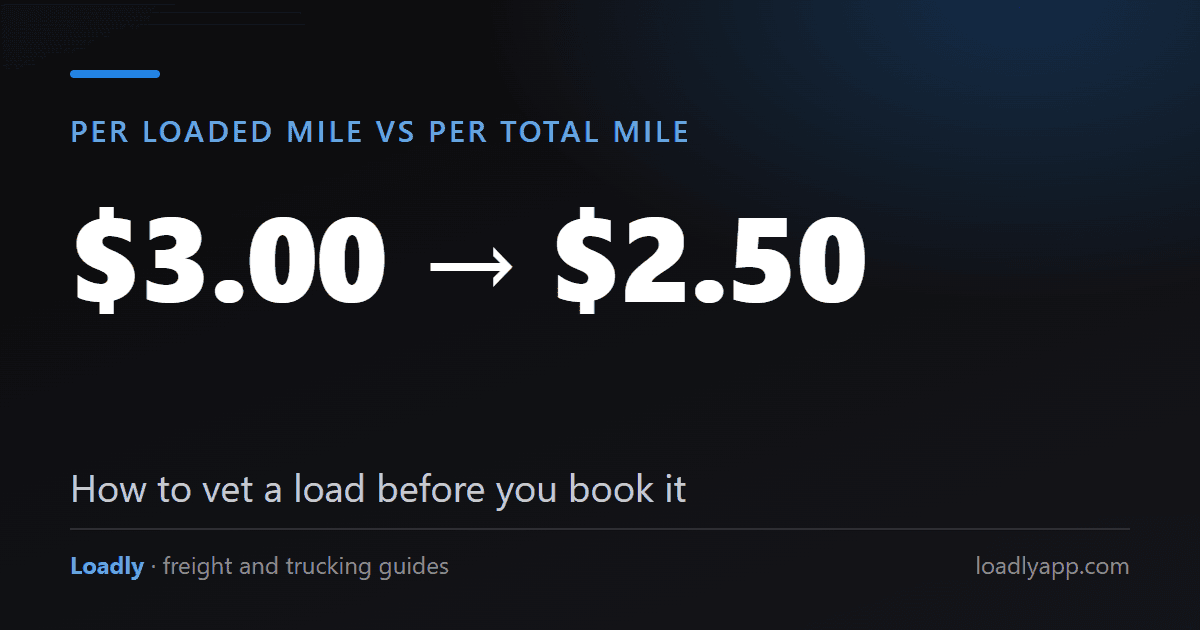
A posted rate looks different depending on which miles you divide by. These figures are invented to show the arithmetic. A load pays $1,800 and runs 600 loaded miles. The truck is 120 miles from the pickup, so it must drive 120 empty miles first.
- Rate per loaded mile: $1,800 ÷ 600 = $3.00.
- Rate per total mile, including the 120 empty miles: $1,800 ÷ (600 + 120) = $1,800 ÷ 720 = $2.50.
The second number is what the truck actually earns for every mile it runs. Comparing two loads on the loaded-mile rate alone can hide that one of them needs a long empty move to reach it. Fuel, tolls, insurance and equipment costs come out of either figure and are not part of this calculation. The Rate Per Mile Calculator does the same arithmetic for any load and can subtract your own running cost.
Payment Terms: What Federal Rules Do and Do Not Say
One rule is often misapplied. The 15-day payment rule in 49 CFR 376.12(f) applies to written leases between an authorized carrier and an owner-operator who leases equipment and driving services to it. It requires the lease to provide that payment is made within 15 days after submission of the necessary delivery documents. It is not a general rule for how fast a broker must pay a carrier. Payment timing between a broker and a carrier is set by their contract, so confirm it in writing before booking, including any quick-pay fee. See Truck Driver Pay: What the Federal Data Shows and How Drivers Are Paid for the lease rules.
Before You Accept: Can You Legally Run It?
- Hours of service: Hours of Service for Truck Drivers: The Limits and Their Exceptions.
- Weight: Federal Axle Weight Limits and the Bridge Formula, Explained.
- Securement: Cargo Securement: How Many Tiedowns and How Strong.
- Which rules apply to a box truck, cargo van or pickup: Box Trucks, Cargo Vans and Pickups: Which Federal Rules Apply by Weight.
Fraud patterns such as double brokering are covered by FMCSA's own guidance. Rate benchmarks for any lane or equipment type, and the features of any particular board, are outside this guide.
Frequently Asked Questions
What is a load board?
An online listing service where freight is posted and carriers search for loads to haul. The board itself is not defined in the federal regulations; what matters is the legal status of the party posting the load.
Do I need operating authority to use a load board?
That depends on your operation. Registration for for-hire carriers comes from 49 U.S.C. 13901, and the weight thresholds for small vehicles are discussed in the box truck and cargo van guide above. Confirm your own case with FMCSA.
Does a broker have to pay me in 15 days?
Not under 49 CFR 376.12(f). That rule governs equipment leases with owner-operators. Broker payment terms are set by contract.
Can I see a broker's records for my load?
Under 49 CFR 371.3(c), each party to a brokered transaction has the right to review the record of that transaction.
Sources
Regulation text: eCFR, 7 October 2026; statutes: Cornell LII. No load board is recommended or ranked.
- 49 U.S.C. § 13102 — Definitions
- 49 U.S.C. § 13901 — Requirement for registration
- 49 U.S.C. § 13904 — Registration of brokers
- 49 U.S.C. § 14706 — Liability of carriers
- 49 CFR § 387.307 — Property broker surety bond or trust fund
- 49 CFR § 371.3 — Records to be kept by brokers
- 49 CFR § 371.7 — Misrepresentation
- 49 CFR § 376.12 — Written lease requirements