Federal weight limits on the Interstate System look simple until a load is spread over several axles. The 80,000-pound gross limit is the number everyone remembers. But a truck can be under 80,000 pounds and still be illegal if too much of that weight sits on a short group of axles. This guide explains the three federal limits in 23 CFR 658.17, how the Bridge Formula works, and how to check a configuration by hand. These are the numbers behind what drivers and loaders call the federal truck weight limit, usually shorthand for the 80,000-pound gross limit.
The Three Limits
Section 658.17 applies to the Interstate System and reasonable access to it. It sets:
- Gross vehicle weight: 80,000 pounds, or less where the Bridge Formula requires a lower figure.
- Single axle: 20,000 pounds on any one axle, including one axle of a group.
- Tandem axles: 34,000 pounds. FHWA defines a tandem as two or more consecutive axles whose centers are spaced more than 40 inches and not more than 96 inches apart.
The rule also says States may not enforce lower limits on the Interstate than 20,000 pounds on a single axle, 34,000 on a tandem, or the weights from the Bridge Formula up to 80,000 pounds. States also may not limit a steering axle to less than 20,000 pounds or the manufacturer's axle rating, whichever is lower. These limits are inclusive of tolerances. The only scale allowance the rule recognizes is for portable scales, and it may not exceed 5 percent. The rule also says that a fine schedule imposing no fine up to a threshold, such as 1,000 pounds, is treated as a tolerance provision that 23 U.S.C. 127 does not authorize.
What the Bridge Formula Does
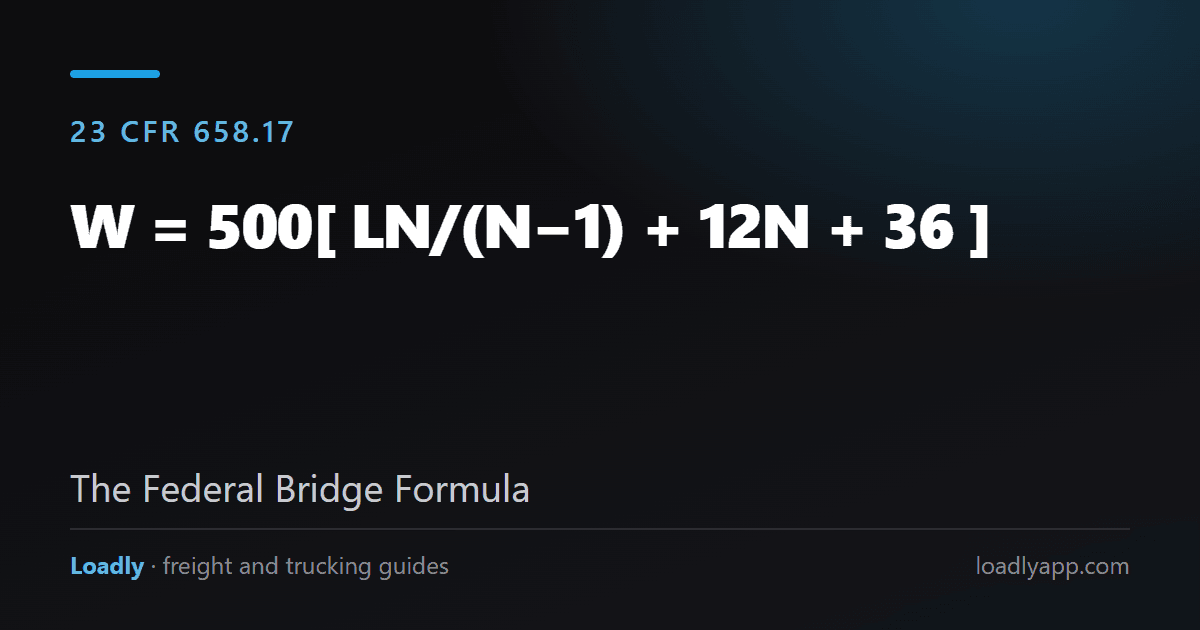
The Bridge Formula limits the total weight on any group of two or more consecutive axles, based on how many axles there are and how far apart the outer ones sit. Spreading the same load over a longer distance puts less stress on a bridge, so a longer, wider-spaced group is allowed more weight. FHWA gives the formula as:
W = 500 × [ (L × N ÷ (N − 1)) + 12N + 36 ]
- W is the maximum weight, in pounds, on the group, to the nearest 500 pounds.
- L is the distance in feet between the outer axles of the group.
- N is the number of axles in the group.
The formula has to be satisfied for every group of consecutive axles on the vehicle, not just the whole truck. The rule also contains one carve-out. Two consecutive sets of tandem axles may each carry 34,000 pounds if the overall distance between the first and last axle of those sets is 36 feet or more. In no case may the total exceed 80,000 pounds.
Checking a Five-Axle Combination
For the common five-axle tractor-semitrailer, put N = 5 into the formula and the only variable left is the distance L from the front axle to the rear axle. The results below are calculated from the formula, not read from a published table:
| Distance between first and last axle (L) | Maximum gross weight for the 5-axle group |
|---|---|
| 36 ft | 70,500 lb |
| 40 ft | 73,000 lb |
| 44 ft | 75,500 lb |
| 48 ft | 78,000 lb |
| 51 ft | 80,000 lb (the formula gives 79,875, which rounds to 80,000) |
The 51-foot, five-axle figure of 80,000 pounds matches the example in FHWA's own bridge formula guidance. That means a five-axle rig with its axles bunched into 40 feet cannot legally carry a full 80,000 pounds even if every individual axle is under its limit. Shifting the trailer's tandem toward the rear, where the design allows it, increases L and therefore the permitted weight. To try other axle counts and spacings, use the Federal Bridge Formula Calculator.
As a check on the formula, take a two-axle tandem (N = 2) with a spacing of 4 feet. It gives W = 500 × [ (4 × 2 ÷ 1) + 24 + 36 ] = 34,000. That matches the tandem limit in 658.17(d).
If every axle is under its limit, is the truck legal?
Not necessarily. The Bridge Formula applies to every group of two or more consecutive axles. A short group can be over its limit even when each axle is under 20,000 pounds and the gross is under 80,000.
Exceptions and Special Cases in the Rule
- Special permits. States may issue special permits without regard to the axle, gross or Bridge Formula limits for nondivisible vehicles or loads.
- Grandfathered weights. The single, tandem and gross limits do not apply to weights legally authorized under State law on 1 July 1956. The group-of-axles requirement does not apply to vehicles grandfathered under State tables or formulas on 4 January 1975.
- Idle-reduction equipment. A vehicle with an auxiliary power or idle-reduction unit may be allowed up to an additional 400 pounds in the gross, axle, tandem or bridge-formula limits. The operator must prove the unit's weight by written certification and meet the rule's other conditions.
- Named locations. The rule exempts specific operations, for example certain specialized vehicles on a stretch of Interstate 68 in Maryland and vehicles on part of Interstate 99 in Pennsylvania.
These limits apply on the Interstate System and reasonable access to it. Permits, routing, escorts and fine amounts for overweight moves are set State by State. Weight is one of several things an inspector can check; Commercial Vehicle Roadside Inspections: What Each Level Covers covers the rest.
Sources
Regulation text: eCFR, 7 October 2026. The formula's variable definitions and the 51-foot example come from FHWA guidance.