A roadside inspection is a rules check against a fixed list, so most of it can be prepared for in advance. For a US driver, the paperwork that matters is short. It is the record of duty status for the previous seven days, a current driver vehicle inspection report if a defect was found, and the vehicle's registration and insurance documents. For a carrier, what matters is what happens after a violation: an out-of-service order stays in force until the listed repairs are done, and the carrier has to certify them. The same applies to commercial drivers who face a DOT inspection on the road.
The Eight Inspection Levels
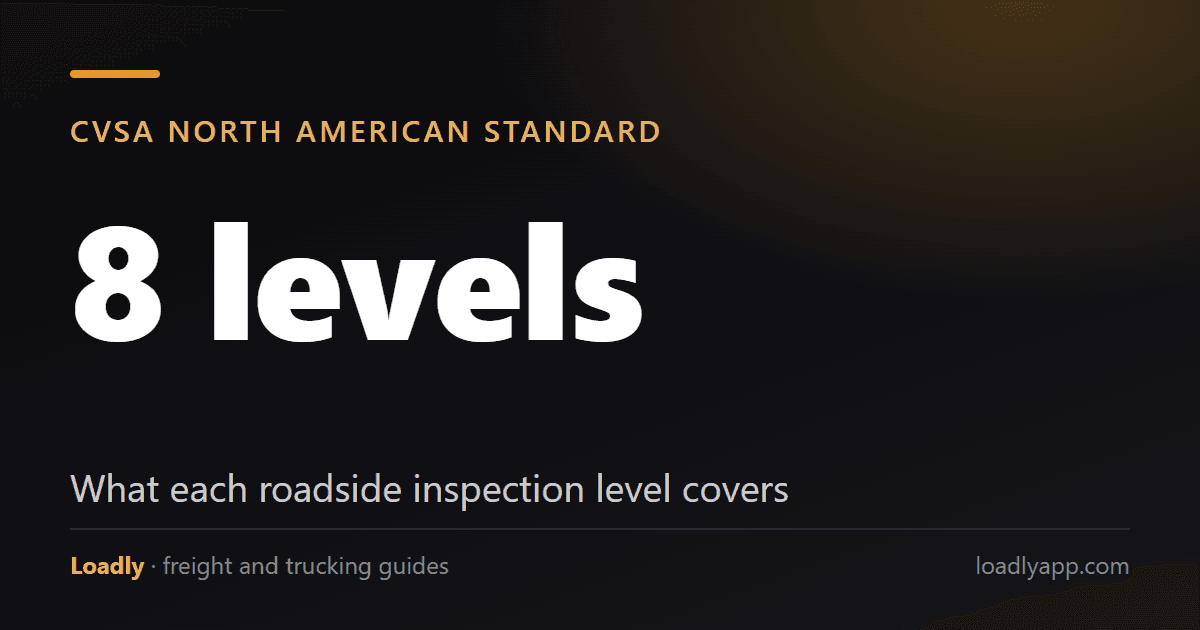
The Commercial Vehicle Safety Alliance (CVSA) defines the North American Standard inspection levels that most US and Canadian enforcement agencies use. There are eight, not seven: Level VIII, the electronic inspection, is the newest. Older guides that list seven levels are out of date.
| Level | Name | What it covers |
|---|---|---|
| I | North American Standard | The most thorough inspection: driver credentials and hours of service, plus the vehicle, including items that require getting under it. |
| II | Walk-Around | Like Level I, but only what an inspector can check without going under the vehicle. |
| III | Driver/Credential | Driver documents only: license, medical certificate, record of duty status and similar items. |
| IV | Special | A one-time check of a single item, often to support a study or confirm a suspected trend. |
| V | Vehicle-Only | The vehicle items of Level I, done without a driver present and at any location. |
| VI | Radioactive Materials | Select radiological shipments, such as highway route controlled quantities. |
| VII | Jurisdictional Mandated | Vehicles not covered by the other levels, such as school buses or taxis, as each jurisdiction requires. |
| VIII | Electronic | An inspection done through a data exchange; the driver does not have to deal with an officer in person. |
For a typical freight driver the practical ones are Levels I, II and III. The difference between them is how much of the truck the inspector is allowed to look at and whether the driver's records are checked.
What the Driver Must Be Able to Show
Record of duty status. Under 49 CFR 395.8, a driver subject to the hours-of-service rules must record duty status for each 24-hour period. Carriers generally have to use an electronic logging device (ELD). The driver has to keep a copy of the record for the previous seven consecutive days available while on duty. There is a limited paper-log allowance for drivers who need records of duty status on no more than eight days in any 30-day period, and for vehicles manufactured before model year 2000. The carrier keeps the records and supporting documents for at least six months.
Medical examiner's certificate. 49 CFR 391.41 requires a driver to be medically certified as physically qualified. From 23 June 2025, CDL and commercial learner's permit holders with a current certificate on file no longer have to carry the paper certificate on them. Where the electronic information from FMCSA differs from a paper copy, the electronic information controls. Drivers who qualify through an FMCSA medical variance still have to carry a copy of that documentation.
Vehicle documents. Registration, insurance evidence and any permits for the load (for example oversize or hazardous materials) belong in the cab. Which ones apply depends on the state and the cargo, so check your own jurisdiction's list rather than relying on a generic checklist.
The Driver Vehicle Inspection Report
49 CFR 396.11 requires a written driver vehicle inspection report (DVIR) at the end of each day's work on each vehicle operated. It must identify the vehicle and list any defect that would affect safe operation or could cause a breakdown, and the driver signs it. The rule lists at least these areas:
- Service brakes, including trailer brake connections, and the parking brake
- Steering mechanism
- Lighting devices and reflectors
- Tires, and wheels and rims
- Horn, windshield wipers and rear-vision mirrors
- Coupling devices
- Emergency equipment
A driver does not have to prepare a report if no defect or deficiency is found. When one is found, the carrier must repair anything that affects safe operation before the vehicle goes out again, and certify that the repair was made or was not needed. Reports and certifications are kept for three months from the date of the report. By the rule's own text, section 396.11 does not apply to a motor carrier operating only one commercial motor vehicle; other inspection duties still apply to such operators, so confirm which. Electronic reports are allowed under 49 CFR 390.32.
The DVIR is also a paper trail. If an inspector finds a brake defect that your last report did not mention, the gap between the two is what looks bad, not just the defect.
What an Out-of-Service Order Means
Under 49 CFR 396.9, an inspector must declare a vehicle out of service if its mechanical condition or loading would likely cause an accident or breakdown. The vehicle is marked with an Out-of-Service Vehicle sticker. After that:
- Nobody may operate the vehicle, and a carrier may not require or allow it, until the repairs listed in the notice are satisfactorily completed. Towing counts as operating it, with the narrow exception of a crane or hoist.
- Nobody may remove the sticker before those repairs are finished.
- The driver must give a copy of the inspection report to the carrier at the next terminal or facility. If the driver will not reach one within 24 hours, the driver must immediately mail, fax or otherwise transmit it.
- Within 15 days of the inspection, the carrier must certify the corrections by completing the signature portion of the form. It must keep a copy for 12 months at its principal place of business or where the vehicle is housed.
This is where an inspection usually turns from a delay into a cost. The truck cannot move on its own and the load is late. The 15-day certification deadline is also easy to miss for a small fleet with no one assigned to inspection paperwork.
A Practical Preparation Routine
- Do the pre-trip against the same list you will be inspected against. Use the areas in 49 CFR 396.11 as your checklist: brakes, steering, lights, tires, wheels, coupling, mirrors, horn, wipers, emergency equipment.
- Check your ELD records before you leave. Make sure the last seven days are complete and the driver knows how to show or transfer them on the device.
- Keep a defect-and-repair file per vehicle. Pair every DVIR with the repair or the "no repair needed" certification so the paper trail answers the inspector's first question.
- Assign someone to out-of-service follow-up. Whoever receives the copy from the driver should know the 15-day certification deadline and the 12-month retention requirement.
- Re-check the rules your drivers carry. The medical certificate rule changed in June 2025. Old internal checklists may still tell drivers to carry paper they no longer need to, or omit documents they do.
Sources
Regulation text: eCFR, current as of 7 October 2026. Inspection level descriptions: CVSA.