Cargo securement rules answer two separate questions: how many tiedowns a load needs, and how strong they have to be in total. A load can pass the first test and fail the second. This guide walks through the federal rules in 49 CFR 393 in the order a driver or loader would apply them, with a worked example. It then covers the on-the-road inspection duty in 49 CFR 392.9. Load securement is a duty for the driver as well as the loader, as the on-the-road inspection rule in 392.9 shows.
The General Requirement
Section 393.100 applies to trucks, truck tractors, semitrailers, full trailers and pole trailers. A commercial motor vehicle carrying cargo on public roads must be loaded and equipped, and the cargo secured, to prevent the cargo from leaking, spilling, blowing or falling from the vehicle. The securement must also prevent shifting that adversely affects the vehicle's stability or maneuverability. Section 393.106(b) adds that cargo must be firmly immobilized or secured by structures of adequate strength, dunnage or dunnage bags, shoring bars, tiedowns, or a combination of these. The general rules do not apply to bulk commodities without structure or fixed shape, such as liquids, gases, grain, sand and gravel, carried in a tank, hopper or box that is part of the vehicle. They do apply to the commodity-specific rules in 393.116 to 393.136, which take precedence where they add requirements.
Question 1: How Many Tiedowns?
Section 393.110 sets a minimum number of tiedowns based on the article's length, and in one case its weight. If the article is not blocked against forward movement by a headerboard, bulkhead, other secured cargo or other blocking device, it must have at least:
| Article | Minimum tiedowns |
|---|---|
| 5 ft or less long and 1,100 lb or less | 1 |
| 5 ft or less long and more than 1,100 lb | 2 |
| More than 5 ft up to 10 ft long, any weight | 2 |
| More than 10 ft long | 2, plus 1 more for every 10 ft of length or fraction beyond the first 10 ft |
If the article is blocked, braced or immobilized against forward movement, the minimum drops. A headerboard, bulkhead, other adequately secured articles or another appropriate method can do the blocking. The article then needs one tiedown for every 10 feet of length or fraction thereof (393.110(c)). The section also contains a special rule for special-purpose vehicles carrying machinery or similar articles.
Question 2: How Strong Must They Be?
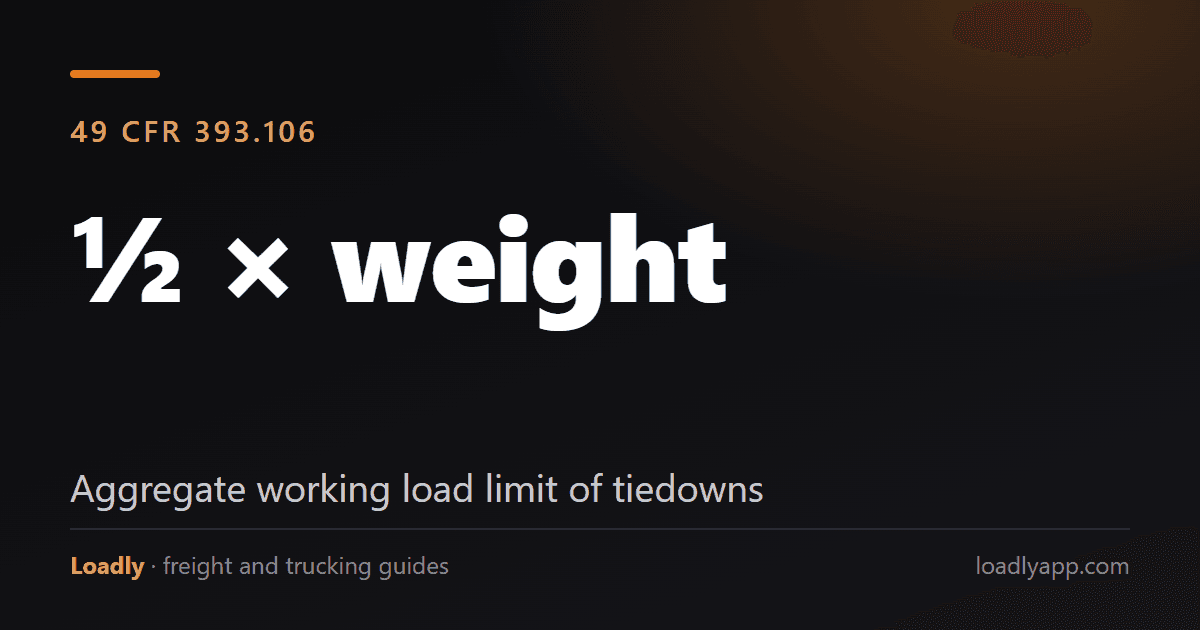
This is the part that catches people. Under 393.106(d), the aggregate working load limit of the tiedowns securing an article or group must be at least one-half times the weight of the article or group. Each tiedown counts differently depending on how it is run:
- A tiedown from an anchor point on the vehicle to an anchor point on the article counts for half its working load limit.
- A tiedown can also run from an anchor on the vehicle, through, over or around the article, and back to another anchor on the same side of the vehicle. That counts for half.
- A tiedown that goes from an anchor on the vehicle through, over or around the article to an anchor on the other side of the vehicle counts for its full working load limit.
The working load limit (WLL) of a tiedown is the lowest WLL of any of its components (including the tensioner) or of the anchor points it is attached to, whichever is less (393.108). The WLL can be taken from the manufacturer's marking or from the tables in the rule. Where tiedown material is unmarked, the rule assigns default values. For example, unmarked welded steel chain is treated as grade 30 proof coil chain.
If I meet the minimum number of tiedowns, am I compliant?
Not automatically. The minimum number in 393.110 is separate from the aggregate working load limit requirement in 393.106(d), and both must be met.
Strapping Down a 12,000-Pound Casting
As an invented example, a steel casting weighs 12,000 lb, is 8 ft long, and is not blocked from moving forward. The straps available are each marked with a working load limit of 1,500 lb.
- Minimum count: the article is more than 5 ft and not more than 10 ft long, so the table gives at least 2 tiedowns.
- Required aggregate WLL: one-half of 12,000 lb is 6,000 lb.
- If the straps pass over the steel casting to the opposite side: each counts 1,500 lb in full, so 6,000 ÷ 1,500 = 4 straps are needed. Two straps would give only 3,000 lb, which meets the count rule but fails the strength rule.
- If the straps run from a vehicle anchor to an anchor on the steel casting: each counts half, 750 lb, so 6,000 ÷ 750 = 8 straps are needed.
The same arithmetic shows why the two rules must both be checked: the minimum number is a floor set by length, and the strength rule can require more.
Downward Force and the Performance Criteria
Section 393.102 sets the performance standard behind these rules. Tiedown assemblies and attachment devices must be designed, installed and maintained so the maximum forces do not exceed the manufacturer's breaking strength. The test conditions are 0.8 g deceleration forward, 0.5 g rearward and 0.5 g lateral. The forces must also not exceed the working load limit under 0.435 g forward, 0.5 g rearward and 0.25 g lateral. Each condition is applied separately. For articles not fully contained within the vehicle's structure, the securement system must also provide a downward force equivalent to at least 20 percent of the article's weight. Cargo is also considered adequately secured if it is immobilized so it cannot shift or tip enough to affect stability. The same holds if it is carried in a sided vehicle with walls of adequate strength, or secured under 393.104 to 393.136.
The Driver's Duty on the Road
Under 392.9, a driver of a truck or truck tractor must assure that cargo is properly distributed and adequately secured before driving. The driver must then inspect the cargo and securement devices within the first 50 miles of a trip and adjust as needed. The driver must reexamine them during the trip. That is required whenever there is a change of duty status, the vehicle has been driven for 3 hours, or it has been driven 150 miles, whichever occurs first. The reexamination rules do not apply to a driver of a sealed vehicle who has been ordered not to open it, or to a vehicle loaded so that inspection is impracticable.
The commodity-specific rules in 393.116 to 393.136 (logs, metal coils, concrete pipe, heavy vehicles and others) add requirements, and the working load limit tables are best read directly in 393.108. For the weight side of heavy loads, see Federal Truck Weight Limits: Axle Limits and the Bridge Formula.
Sources
Regulation text: eCFR, 7 October 2026.
- 49 CFR § 393.100 — Applicability and general requirements of cargo securement standards
- 49 CFR § 393.102 — Minimum performance criteria for cargo securement devices and systems
- 49 CFR § 393.106 — General requirements for securing articles of cargo
- 49 CFR § 393.108 — Determining the working load limit of a tiedown
- 49 CFR § 393.110 — Additional requirements for determining the minimum number of tiedowns
- 49 CFR § 392.9 — Inspection of cargo, cargo securement devices and systems