When freight is lost or damaged, two sets of clocks start running: the claimant's time to file and sue, and the carrier's time to respond. They come from different sources. The claimant's minimums sit in the federal statute, 49 U.S.C. 14706, and the carrier's response duties are in the claims regulations, 49 CFR part 370. This guide lines them up so you can see who owes what, and by when.
Who Is Liable
Under 49 U.S.C. 14706(a), a motor carrier subject to the Interstate Commerce Act's jurisdiction must issue a receipt or bill of lading for property it receives for transportation. The receiving carrier, the delivering carrier and any other carrier over whose line the property moves under a through bill of lading are liable. They are liable to the person entitled to recover under the bill of lading, for the actual loss or injury to the property. A failure to issue a bill of lading does not affect that liability. The statute also lets a carrier that pays recover from the carrier over whose line the loss occurred. Carriers can in some circumstances limit their liability under the statute's special rules, which this article does not cover, so the bill of lading and any agreed value matter.
What Counts as a Freight Claim
A claim has to be a written communication filed with a proper carrier within the time limits in the bill of lading or contract of carriage. Under 49 CFR 370.3(b) it must contain three things:
- Facts sufficient to identify the shipment or shipments;
- An assertion of liability for the alleged loss, damage, injury or delay; and
- A claim for payment of a specified or determinable amount of money.
Several things that feel like claims are not. The rule says bad order reports, appraisal reports, notations of shortage or damage on freight bills or delivery receipts, and inspection reports, standing alone, are not enough. A claim for an uncertain amount, such as "$100 more or less," obliges the carrier to investigate. The carrier may not pay it voluntarily until a formal written claim for a specified or determinable amount has been filed. If other carriers receive similar claims on the same shipment, the carrier investigating must notify all claimants of the conflicting claims and require further substantiation of title or right to the claim.
The Carrier's Response Clock
Once it receives a proper written claim, the carrier has two duties with set deadlines:
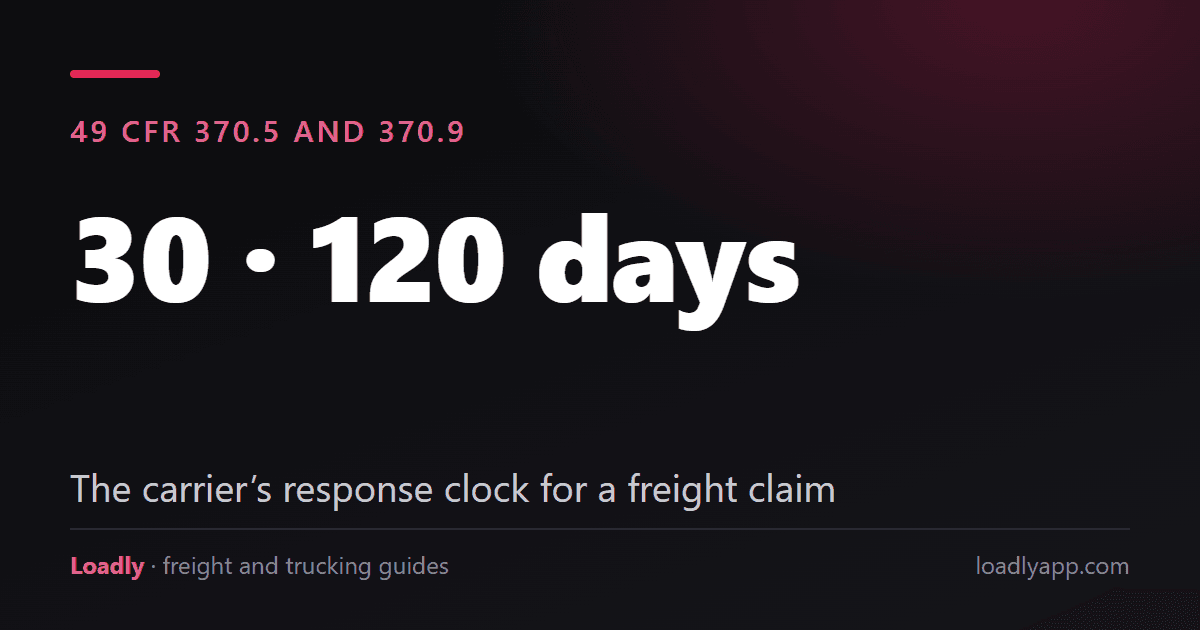
- 30 days: acknowledge. Under 370.5, the carrier must acknowledge the claim in writing within 30 days of receipt, unless it has paid or declined the claim in writing within 30 days. The acknowledgment must say what, if any, additional documents or information it needs. The carrier must open a separate file with a claim number and record the date of receipt on the claim and in its acknowledgment.
- 120 days: pay, decline or make a firm offer. Under 370.9, the carrier must pay, decline, or make a firm compromise settlement offer in writing within 120 days of receiving the claim. If it cannot finish within 120 days, it must tell the claimant in writing at that point. It must do so again at the end of every following 60-day period while the claim is pending, giving the status and the reason for the delay, and keep a copy in the claim file.
The Claimant's Minimum Periods
Under 49 U.S.C. 14706(e), a carrier may not provide a period of less than 9 months for filing a claim against it. It also may not provide less than 2 years for bringing a civil action. This holds whether the period is set by rule, contract or otherwise. The 2 years run from the date the carrier gives written notice that it has disallowed any part of the claim specified in the notice. Two special rules protect claimants. An offer of compromise is not a disallowance unless the carrier tells the claimant in writing that part of the claim is disallowed and gives reasons. And communications from a carrier's insurer are not a disallowance unless the insurer says so in writing, gives reasons, and says it acts on behalf of the carrier.
A bill of lading can therefore set a longer period than the statutory minimum but not a shorter one. The clock for suing does not start from a phone call or an informal "no."
A Short Checklist for Claimants
- Note any damage or shortage on the delivery receipt at delivery, but do not treat that as the claim.
- Send a separate written claim that identifies the shipment, asserts the carrier's liability, and states a specific or determinable amount.
- Keep the date it was received, and the claim file number from the carrier's acknowledgment.
- Calendar day 30 for the acknowledgment and day 120 for the response.
- Calendar the bill of lading's own filing deadline, and never assume it is shorter than 9 months or that a suit deadline is shorter than 2 years from written disallowance.
How much a carrier owes depends on the bill of lading and its valuation terms. Household goods moves, claims against brokers, and ocean or air shipments follow other rules. For the insurance the carrier itself must hold, see Truck Insurance Requirements: The Federal Minimum Liability Levels.
Frequently Asked Questions
Does a note on the delivery receipt count as a claim?
No. Under 49 CFR 370.3(c), notations of shortage or damage on freight bills or delivery receipts, standing alone, are not enough to meet the minimum claim filing requirements.
How long does a carrier have to respond?
It must acknowledge in writing within 30 days of receipt. It must pay, decline or make a firm compromise offer in writing within 120 days, with written status updates every 60 days if it needs longer.
What is the shortest period a carrier can allow me to file a claim?
Nine months, under 49 U.S.C. 14706(e)(1). A carrier may allow more but not less.
When does the two-year period to sue start?
From the date the carrier gives written notice that it has disallowed any part of the claim. An offer of compromise does not start it unless the carrier also states in writing, with reasons, that part of the claim is disallowed.
How do I file a cargo damage claim?
Send the carrier a written claim that identifies the shipment, asserts liability for the loss or damage, and states a specific or determinable amount (49 CFR 370.3(b)). A note on the delivery receipt alone is not enough.
Sources
Regulation text: eCFR, 7 October 2026; statute: Cornell LII. For a live dispute, a transportation lawyer can say how this applies to your facts.