"Freight broker" is a legal term, not just a job title. U.S. law defines who counts as a broker, requires brokers to register, and sets financial and conduct rules for them that carriers and shippers do not face in the same way. This guide explains the definition, how a broker differs from a carrier and a freight forwarder, what the statute requires of a registered broker, and why a dispatcher is not the same thing. It does not give earnings figures or a step-by-step application guide, for reasons explained below. In everyday use the same business may be called a freight broker, a truck broker or a logistics broker. The statute uses the single term broker, and what counts is what the company does.
The Legal Definition
Under 49 U.S.C. 13102(2), a broker is a person, other than a motor carrier or an employee or agent of a motor carrier. Such a person, as a principal or agent, sells, offers for sale, negotiates for, or holds itself out by solicitation, advertisement or otherwise as selling, providing or arranging for, transportation by motor carrier for compensation. The federal regulations in 49 CFR 371.2 say much the same: a broker is a person who, for compensation, arranges or offers to arrange the transportation of property by an authorized motor carrier.
Two features of the definition matter. First, a broker does not haul the freight. The definition is about arranging transportation that a motor carrier performs. Second, "holds itself out" is part of it: a company that advertises that it will arrange transportation can be a broker even if it describes itself differently.
Broker, Carrier, Forwarder and Dispatcher
| Role | What the law says |
|---|---|
| Motor carrier | A person providing motor vehicle transportation for compensation (13102(14)). It is the party that moves the freight. |
| Broker | Arranges transportation by a motor carrier for compensation, and is not itself a motor carrier or an employee or agent of one (13102(2)). |
| Freight forwarder | Holds itself out to the public to provide transportation of property for compensation and, in the ordinary course of its business, assembles and consolidates shipments, assumes responsibility for the transportation from the place of receipt to the place of destination, and uses a carrier subject to the statute for part of the transportation (13102(8)). |
| Dispatcher | Not a defined term in 49 U.S.C. 13102. The safety regulations in 49 CFR 390.5 mention employees responsible for dispatching drivers as part of what the term "motor carrier" includes. |
| Shipper | Not defined as a term in 49 U.S.C. 13102 either; it is generally the party tendering the goods for transportation. |
The difference between a broker and a freight forwarder comes down to responsibility. The forwarder definition says it assumes responsibility for the transportation from receipt to destination; the broker definition is about selling, negotiating for, or arranging transportation. Whether a particular company is a broker or a forwarder depends on what it actually does and how it holds itself out. A dispatcher usually works for a carrier, finding and scheduling loads for its drivers. Because the term has no statutory definition, check what a given business is registered as and what its contract says, rather than relying on the label.
Registration and Eligibility
Under 49 U.S.C. 13901, a person may act as a broker for transportation subject to the Act only if registered. Section 13904 sets the conditions:
- The Secretary registers a person as a broker if two things hold (13904(a)). The person has sufficient experience to qualify to act as a broker. The person is also fit, willing and able to be a broker and to comply with the statute and regulations.
- Each broker must employ, as an officer, an individual with at least three years of relevant experience. The alternative is an individual who gives the Secretary satisfactory evidence of knowledge of related rules, regulations and industry practices (13904(c)).
- A broker may not provide transportation as a motor carrier unless it has also registered separately as a motor carrier. This does not apply to a motor carrier or its employee or agent in some cases. The transportation must be provided entirely by that carrier, with other registered motor carriers, or with rail or water carriers (13904(d)).
- A broker must update its registration within 30 days of a change in its address, contact information, officers, process agent, or other essential information (13904(g)).
- A broker, like a motor carrier, must designate an agent in each State in which it operates, on whom court process can be served (49 U.S.C. 13304).
FMCSA's registration pages describe the practical side. Operating authority appears as an MC, FF or MX number depending on the type granted. A separate fee is paid for each kind of authority sought. FMCSA lists $300 for permanent authority and does not refund fees for mistaken applications. First-time applicants register through the Unified Registration System, which FMCSA says may take 20 to 25 business days, and longer if the application needs further review. Whether authority has been granted can be checked on FMCSA's Licensing and Insurance website. FMCSA also says it is moving registration to a new system called Motus, so follow the steps on its site as they stand when you apply.
Financial Security
Section 13906(b) says a person can be registered as a broker only if it files a surety bond, proof of trust fund, or other financial security. The Secretary must determine that its form and amount, and its provider, are adequate. A trust fund or other security may be accepted only if it consists of assets readily available to pay claims without resort to personal guarantees or collection of pledged accounts receivable. The security is available to pay any claim arising from the broker's failure to pay freight charges under its contracts. This applies in three situations. The broker consents to payment. Or the broker fails to respond to adequate notice and the surety determines the claim is valid. Or the claim remains unresolved after a reasonable attempt to resolve it and has been reduced to a judgment against the broker. A surety that receives notice of a claim must respond within 30 days, and a denial must state the grounds in writing.
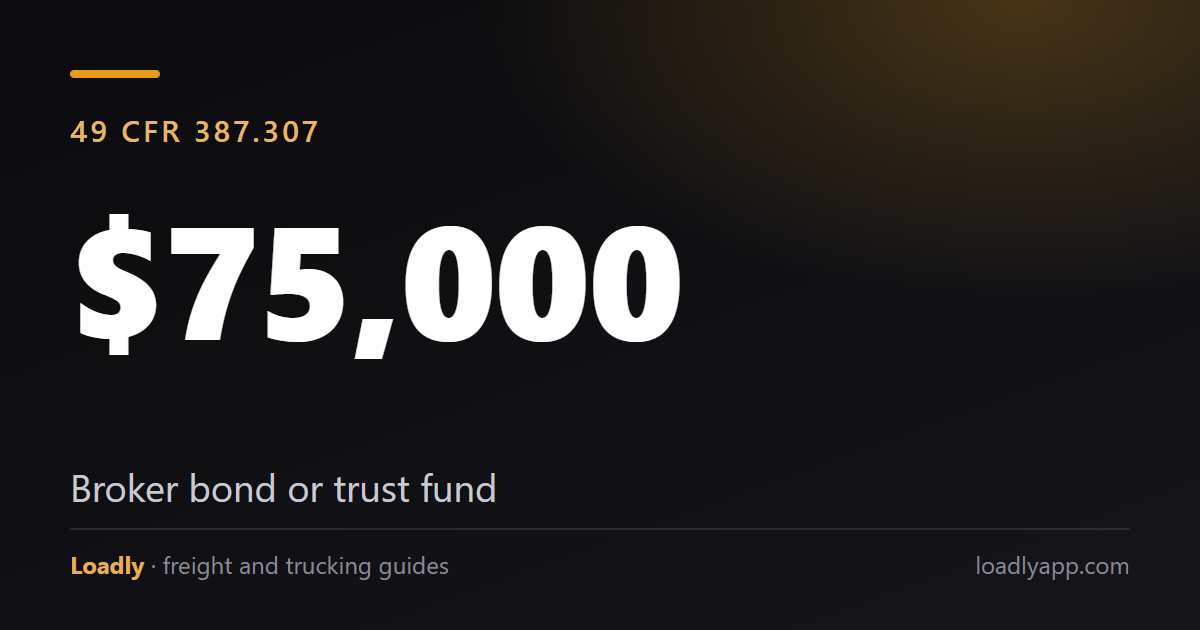
The regulation that sets the amount is 49 CFR 387.307, which requires $75,000. The full detail, including what happens when claims draw the bond below that amount, is in Freight Broker Bond and Trust Fund Rules, Explained.
Conduct Rules for Registered Brokers
- Keep a record of each transaction for three years (49 CFR 371.3). It includes the consignor, the originating carrier and its registration number, the bill of lading or freight bill number, the compensation received and who paid it, and the date freight charges were paid to the carrier.
- Do not operate under a name other than the one on the registration, and do not represent operations as those of a carrier (371.7).
- Do not charge a carrier for brokerage service where the broker owns or has a material beneficial interest in the shipment, or controls it through common ownership with the shipper. Do not give shippers, consignors or consignees anything of value beyond inexpensive advertising items (371.9).
Where a Broker's Margin Comes From
These numbers are invented for the arithmetic. A shipper agrees to pay a broker $2,000 to move a load. The broker contracts with a motor carrier and agrees to pay the carrier $1,700. The broker's gross margin on the load is $2,000 − $1,700 = $300, which is 15 percent of the amount the shipper paid. Under 371.3 the broker must record the compensation it received for the service and who paid it. The broker's own costs, such as staff, software and bond premiums, come out of that margin. Federal law does not set what a broker may earn.
This guide gives no earnings figure because the sources it relies on do not publish one. Household goods and passenger brokers have additional rules, and the registration forms and steps change, so follow FMCSA's current instructions when you apply.
Frequently Asked Questions
What is a freight broker?
A person, other than a motor carrier or an employee or agent of one, that sells, negotiates for, or arranges transportation by motor carrier for compensation, as defined in 49 U.S.C. 13102(2).
Is a freight broker the same as a dispatcher?
Not by definition. "Broker" is a defined, registered category. "Dispatcher" is not defined in 49 U.S.C. 13102; a dispatcher typically schedules and finds loads for a carrier's drivers.
What is the difference between a broker and a freight forwarder?
A forwarder, as defined, assembles and consolidates shipments and assumes responsibility for the transportation from receipt to destination, using carriers for part of it. A broker's definition centers on selling, negotiating for, or arranging transportation by a motor carrier.
What experience does a broker need?
Under 49 U.S.C. 13904(c), each broker must employ as an officer someone with at least three years of relevant experience. The alternative is someone who provides satisfactory evidence of knowledge of the related rules, regulations and industry practices.
What are the requirements for becoming a freight broker?
Federal law requires several things of a broker. These are registration and a determination that the person has sufficient experience and is fit, willing and able to comply. They also include an officer with at least three years of relevant experience or satisfactory evidence of knowledge of the rules, a $75,000 bond or trust fund, and a designated process agent in each State where the broker operates (49 U.S.C. 13904, 13906, 13304; 49 CFR 387.307). FMCSA describes the application, fees and timing on its registration pages, and the main points are summarized above.
Sources
Statutes: Cornell LII; regulations: eCFR, 7 October 2026; registration details: FMCSA, read 11 October 2026.
- 49 U.S.C. § 13102 — Definitions
- 49 U.S.C. § 13901 — Requirement for registration
- 49 U.S.C. § 13904 — Registration of brokers
- 49 U.S.C. § 13906 — Security of motor carriers, motor private carriers, brokers, and freight forwarders
- 49 U.S.C. § 13304 — Service of process
- 49 CFR § 371.2 — Definitions
- 49 CFR § 371.3 — Records to be kept by brokers
- FMCSA — Get Operating Authority (Docket Number)
- 49 CFR § 390.5 — Definitions