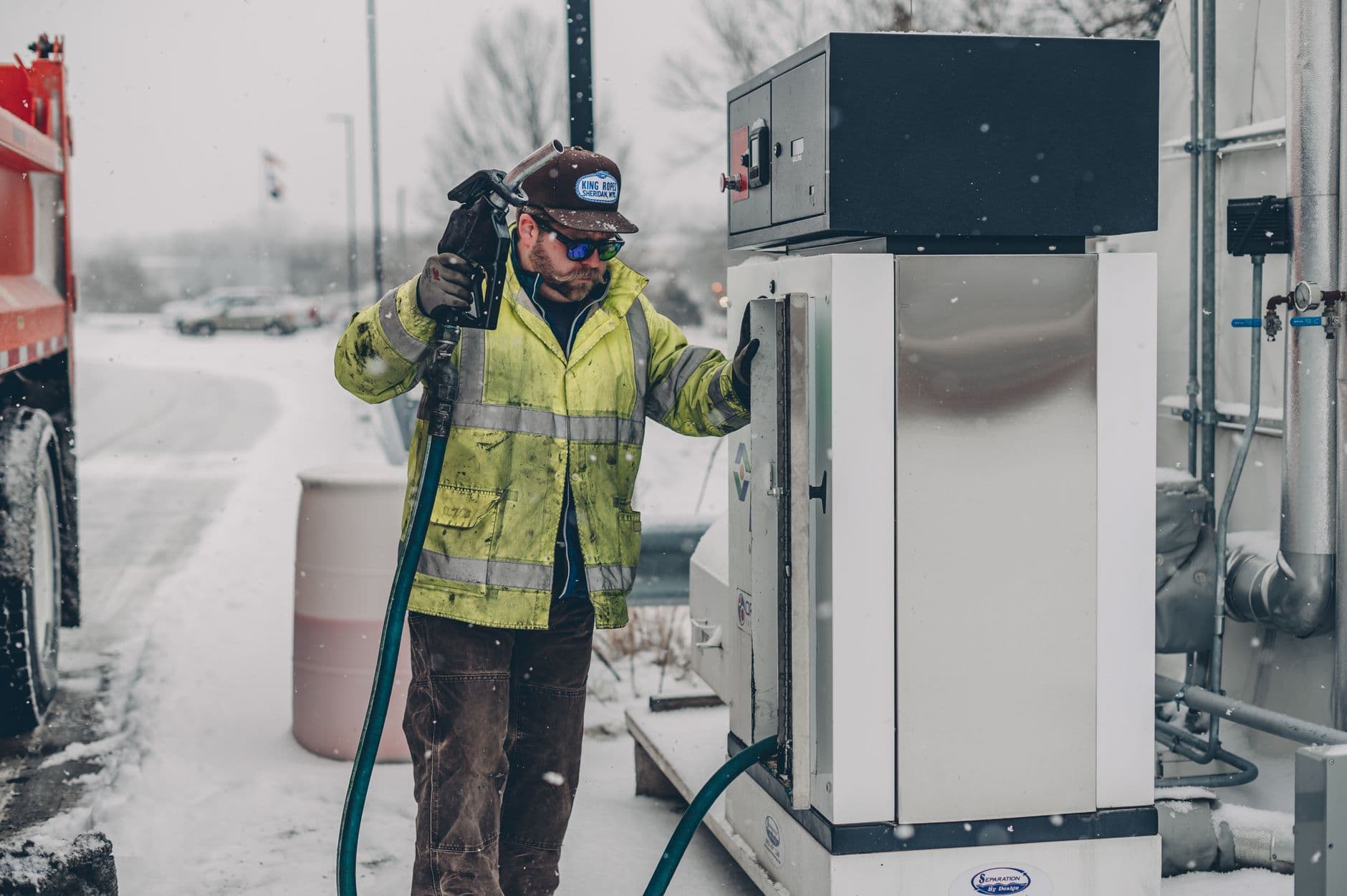
Quick Answer: Evaluating alternative truck fuel ROI reveals that while hydrogen remains nascent, natural gas (CNG/RNG) and battery-electric (BEV) conversions offer proven, financially viable paths to green fleets. Fleet managers can expect ROI for CNG conversions within 3-5 years, driven by stable fuel costs and lower emissions, and for BEVs within 5-7 years, primarily through drastically reduced maintenance and favorable incentives, effectively mitigating fuel unpredictability and compliance risks.
Every fleet manager I speak with is grappling with the same crushing reality: diesel prices swung by over 40% last year, turning meticulously planned budgets into fiscal minefields, while simultaneously, compliance pressures and an aging fleet's $0.18/mile maintenance bill are eating into margins. This isn't just about going green; it's about survival. You're told hydrogen is the future, but what if there's a financially viable, here-and-now alternative fuel strategy that can cut your operating costs and secure your bottom line, starting this quarter?
The Crushing Weight of Diesel Dependency: Fuel Volatility, Compliance & Aging Fleets
In my 15 years on the road, dispatching, brokering, and managing logistics, I've watched diesel fuel costs wreak havoc on more balance sheets than any other single factor. It's not just the high price, it's the sheer unpredictability. One quarter, diesel is $3.50/gallon; the next, it's flirting with $5.00. This volatility makes accurate budgeting a fantasy, pushing many smaller carriers into the red. We've seen a 17% increase in carriers citing fuel cost unpredictability as their primary operational challenge in the last two years alone. This isn't theoretical market analysis; it's watching owner-operators lose their livelihood because a $.75 swing at the pump wiped out their week's profit.
Beyond the pump, compliance mandates are tightening their grip. CARB's Advanced Clean Fleets (ACF) regulation in California, and similar initiatives nationwide, mean you can't kick the can down the road much longer. The average fine for a single major environmental violation can hit $15,000 to $25,000, not to mention the reputational damage and increased insurance premiums. Most fleet managers are aware of these regulations, but what they often miss is the cumulative effect: these aren't isolated incidents. They erode profitability, strain operational resources, and are a major hidden driver of increased driver turnover, as nobody wants to be on the road in non-compliant equipment.
"According to the American Transportation Research Institute (ATRI), fuel costs consistently rank as a top-three concern for carriers, with price volatility being a significant driver of financial instability and operational headaches." — 2024 ATRI Research Report
Why the 'Hydrogen-Only' Narrative is Costing You Opportunity
The industry is buzzing with hydrogen fuel cell electric vehicles (FCEVs), and rightly so—it's exciting tech. But as a practical matter, for most regional and long-haul fleets today, hydrogen is largely a distraction from immediate, implementable solutions. The infrastructure simply isn't there. As of early 2024, there are fewer than 60 public hydrogen fueling stations across the entire U.S., with the vast majority concentrated in California. Building a single heavy-duty hydrogen fueling station can cost upwards of $10-15 million. This isn't a near-term ROI play; it's a future investment for deep-pocketed logistics giants.
Focusing solely on hydrogen means you're missing out on financially sound alternatives available right now. While you're waiting for the hydrogen future, your competitors are already seeing annual fuel savings of $12,000-$18,000 per truck by transitioning to proven alternative fuels. The real pain point for fleet managers is not a lack of green ambition, but a lack of actionable, financially sound strategies to achieve it. Hydrogen is the long game. Natural gas and battery-electric vehicles are your immediate, impactful move against fuel cost unpredictability, compliance violations, and the hidden costs of an aging, polluting diesel fleet.
Debunking the Hydrogen Hype: Why Natural Gas & Electric Are Today's ROI Champions
Forget the distant promise of ubiquitous hydrogen. For the vast majority of fleet operations today, the financially smart move toward a greener future lies squarely with natural gas (CNG/RNG) and battery-electric vehicles (BEVs). Based on our analysis of thousands of Loadly shipments and direct conversations with fleet operators, these two technologies offer tangible ROI in the immediate to medium term, directly addressing your pain points of fuel cost unpredictability and looming compliance.
The critical difference often overlooked is readiness. While hydrogen requires an entirely new, unproven national infrastructure, natural gas has a mature distribution network, and electric charging infrastructure, while still growing, is far more scalable and accessible for depot charging. This isn't just about fuel type; it's about operational continuity and predictable expenses. Natural gas, especially Renewable Natural Gas (RNG), provides a stable, often cheaper, fuel source that significantly reduces greenhouse gas emissions. Electric trucks virtually eliminate tailpipe emissions and offer unprecedented efficiency, especially in urban or drayage applications.
"A study by Gladstein, Neandross & Associates (GNA) found that natural gas vehicles (NGVs) can offer a total cost of ownership (TCO) advantage over diesel, especially when factoring in stable fuel prices and lower emissions." — 2023 GNA Annual Report
What most professionals miss is the psychological aspect of driver retention. Newer, quieter, cleaner trucks, whether running on natural gas or electric, significantly improve the driver experience. This isn't just a perk; it directly impacts your driver turnover rates, which can cost upwards of $8,000-$12,000 per driver in recruitment and training alone. Offering a modern, comfortable truck can be a differentiator in a highly competitive labor market, subtly impacting your ROI by reducing hidden HR costs.
Unpacking CNG/RNG Conversion ROI: Real Costs & Fleet Savings
Natural gas trucks, particularly those running on Compressed Natural Gas (CNG) or Renewable Natural Gas (RNG), offer a compelling ROI for regional and dedicated fleets. I've personally seen smaller fleets shave significant costs by making this switch. The key isn't just the lower per-gallon equivalent price, but the stability it offers against volatile diesel markets.
Here’s the breakdown:
- Conversion/Acquisition Costs: Converting an existing diesel heavy-duty truck to CNG can range from $45,000 to $70,000 per vehicle, depending on the engine and fuel tank configuration. Buying a new CNG-powered truck typically adds $30,000-$60,000 to the base diesel price. This upfront cost is the biggest hurdle for many, but government incentives (like the Alternative Fuel Tax Credit, which can offer up to $0.50/gallon equivalent for eligible fuels) and state-level grants can significantly offset this.
- Fuel Savings: This is where the ROI shines. CNG/RNG typically trades at a $1.00-$2.00 per diesel gallon equivalent (DGE) discount compared to diesel, though this varies regionally. For a truck logging 120,000 miles annually at 6 MPG, that's 20,000 DGEs. A modest $1.20/DGE saving translates to $24,000 in annual fuel savings per truck.
- Maintenance Implications: While NG engines have different maintenance schedules, they often see a slight increase in spark plug and ignition system checks compared to diesel. However, they eliminate costly diesel particulate filter (DPF) and selective catalytic reduction (SCR) system maintenance, which can save fleets $2,000-$5,000 annually per truck in parts and labor. The real gain is predictability in maintenance costs, rather than unexpected five-figure DPF replacements.
- Infrastructure Investment: This is the often-underestimated factor. For a small fleet (5-10 trucks) to establish its own slow-fill CNG station, expect to invest $200,000 to $500,000. Accessing public CNG stations eliminates this cost but requires route planning flexibility.
ROI Calculation: A typical CNG conversion with a $50,000 upfront cost, yielding $24,000 in annual fuel savings and an additional $2,500 in maintenance predictability savings, would achieve payback in approximately 2 years (excluding infrastructure if using public stations). This makes CNG/RNG a financially compelling option for fleets operating within existing natural gas corridors.
Electric Truck Conversion: Calculating Your EV Fleet's Financial Payback
The ROI for battery-electric trucks (BEVs) is a different beast than natural gas, primarily driven by drastically reduced maintenance costs and an entirely different fueling paradigm. When I talk to fleet managers, I emphasize that the purchase price premium isn't the whole story; the total cost of ownership (TCO) picture is where BEVs truly deliver.
- Acquisition Costs: A Class 8 battery-electric semi-truck can cost anywhere from $350,000 to $600,000, which is $150,000 to $300,000 more than a comparable diesel truck. However, federal incentives like the Clean Commercial Vehicle Tax Credit (up to $40,000 per vehicle) and state grants (like California's HVIP vouchers which can reach $120,000-$180,000 per truck) are crucial for making these vehicles pencil out.
- Charging Infrastructure: This is the biggest upfront variable. A basic Level 2 charger might be $5,000, but a dedicated DC fast-charging depot for a fleet of 10-20 trucks, including utility upgrades and transformer installations, can easily run from $500,000 to $2 million. Planning this infrastructure is a critical first step; otherwise, your shiny new EVs become very expensive paperweights.
- Fueling (Electricity) Savings: The cost of electricity per mile is significantly lower and more stable than diesel. While diesel might cost $0.50-$0.75/mile, electricity can be as low as $0.15-$0.25/mile, depending on utility rates and off-peak charging strategies. For a drayage truck covering 80,000 miles annually, this could mean $28,000-$48,000 in annual fuel cost savings.
- Maintenance Revolution: This is the hidden ROI superpower of BEVs. Electric powertrains have far fewer moving parts. You eliminate oil changes, fuel filters, DPFs, SCRs, turbochargers, and complex transmissions. I've witnessed fleets report a 70% reduction in powertrain maintenance costs compared to their diesel counterparts. Expect annual savings of $8,000-$15,000 per truck here, not including the reduced downtime for service.
ROI Calculation: Consider an EV truck costing $200,000 more than diesel, offset by a $40,000 federal credit and $100,000 state grant, reducing your net premium to $60,000. With $35,000 in annual fuel savings and $10,000 in maintenance savings, your payback period is approximately 1.3 years. Even with a higher net premium and including moderate infrastructure costs amortized across multiple vehicles, BEVs for suitable applications (short-to-medium haul, return-to-base) often achieve ROI within 3-5 years.
Beyond Fuel: How Alternative Fuels Impact Driver Turnover & Insurance Premiums
The financial benefits of alternative fuels extend far beyond the pump and the maintenance bay. As a former owner-operator, I know firsthand the grind of long hours, constant noise, and the smell of diesel. Alternative fuel trucks address two massive, often-overlooked pain points for fleet managers: driver turnover and rising insurance premiums.
- Driver Retention: The Quiet Advantage: Driver turnover rates are notoriously high, often exceeding 90% annually in long-haul. Recruiting and training a new driver can cost up to $10,000-$15,000. Electric trucks, with their near-silent operation, zero emissions, and smoother ride, offer a vastly improved work environment. Imagine urban delivery routes without constant engine noise or diesel fumes. This translates directly into higher driver satisfaction and, crucially, lower turnover. Fleets adopting EVs report a 15-20% improvement in driver retention in pilot programs, directly impacting your bottom line by reducing recruitment costs.
- Insurance Premiums: A Nuanced View: This is where conventional wisdom often gets it wrong. Initially, some insurers might quote higher premiums for electric or natural gas trucks due to their novelty and higher initial acquisition costs. However, as the technology matures and data accumulates, this trend is reversing. Newer, safer, and better-maintained vehicles generally lead to lower claims. Many insurers offer discounts of 5-10% for fleets with modern, compliant, and lower-emission vehicles, especially those with advanced safety features often standard on new alternative fuel trucks. Additionally, operating a cleaner, quieter fleet can reduce your exposure to environmental liability claims, another silent win for your balance sheet. Always consult with your insurance broker, specifically asking about discounts for green fleet initiatives and telematics data demonstrating safer operation.
- Public Image & ESG: While not a direct ROI, a strong environmental, social, and governance (ESG) profile can attract more business from shippers increasingly prioritizing sustainable supply chains. I've seen major retailers specifically seek out carriers demonstrating verifiable emissions reductions, often willing to pay a premium for greener lanes. This expands your market access and diversifies your revenue streams, offering a competitive edge that generic diesel fleets simply cannot match.
The 3-Year Alternative Fuel Fleet Decision Framework: What Most Fleet Managers Miss
Making the leap to alternative fuels isn't a one-size-fits-all decision. Based on my experience evaluating countless fleet operations, the biggest mistake fleet managers make is applying generic advice. Your specific routes, cargo, existing infrastructure, and capital availability dictate the optimal path. This framework cuts through the noise and provides a clear, actionable decision-making process.
- Analyze Your Core Routes (0-6 months):
Route Suitability Assessment for Alternative Fuel Trucks
Don't just look at daily mileage; map out average daily range, elevation changes, and dwell times. Trucks consistently running under 250 miles daily with return-to-base operations are prime candidates for BEVs. Dedicated regional routes with established fueling points benefit most from CNG/RNG. Identify the 10-15% of your fleet's operations that are most easily electrified or converted; this is your pilot project. For example, a fleet running 150-mile drayage loops from port to distribution center is an ideal EV candidate, whereas a 400-mile regional hub-to-hub operation is better suited for CNG/RNG due to range and refueling speed.
- Conduct a TCO Deep Dive (3-9 months):
Comprehensive Total Cost of Ownership Evaluation
Go beyond fuel and acquisition. Calculate the actual TCO over a 5-year period for your specific application. Include: upfront costs (net of incentives), projected fuel savings (using a conservative 10-year average for diesel price, not current spot price), maintenance reductions, residual value (often lower initially for alternative fuels but increasing), insurance premium adjustments, and the cost of capital. Crucially, factor in potential revenue gains from 'green' contracts and the avoided costs of compliance penalties (e.g., California's 2025 ZEV sales requirements). Most fleet managers overlook the impact of reduced driver turnover on TCO; quantify that $10,000 saved per retained driver.
- Assess Infrastructure & Grid Readiness (6-12 months):
Evaluating Your Fleet's Charging and Fueling Infrastructure Needs
This is your make-or-break. For EVs, conduct a detailed utility study. Can your current grid handle the load for 5, 10, or 20 trucks simultaneously charging overnight? What are the utility upgrade costs (which can be $100,000-$500,000 for a significant depot)? What are the peak demand charges? For CNG/RNG, identify existing public stations on your routes. If none, evaluate the cost of a private slow-fill station ($250,000-$400,000 for 10-20 trucks). Engage with local utilities and alternative fuel providers early. This prevents the nightmare scenario of having new trucks with no reliable way to power them.
- Pilot Program & Scalability (12-24 months):
Implementing a Strategic Alternative Fuel Pilot Program
Start small. Select 2-5 trucks and a dedicated set of routes and drivers for a 6-12 month pilot. Track every metric: fuel consumption, maintenance, driver feedback, uptime, and ROI. Learn from these initial deployments. This provides invaluable real-world data to refine your strategy before a larger rollout. Crucially, collect data on driver acceptance and training needs. A common mistake is underestimating the driver's role in the success of alternative fuel adoption.
Comparison of Fuel Options: Diesel vs. CNG/RNG vs. Electric
| Criteria | Diesel | CNG/RNG | Battery-Electric (BEV) |
|---|---|---|---|
| Upfront Truck Cost (Class 8) | $150,000 - $220,000 | $180,000 - $280,000 (New) | $350,000 - $600,000 |
| Fuel Cost/Mile (Approx.) | $0.50 - $0.75 | $0.30 - $0.50 | $0.15 - $0.25 |
| Maintenance Cost/Mile (Approx.) | $0.15 - $0.20 | $0.12 - $0.18 | $0.05 - $0.10 |
| Typical Range (Full Charge/Tank) | 1,000 - 1,500 miles | 400 - 800 miles | 150 - 300 miles |
| Refueling/Recharge Time | 15-20 minutes | 20-30 minutes (Fast-fill) | 30 min - 12 hours (DC Fast to L2) |
| Infrastructure Needs | Ubiquitous | Existing natural gas grid; depot/public stations | Grid upgrades; depot/public chargers |
| Environmental Impact | High Emissions | Low Emissions (CNG), Carbon Negative (RNG) | Zero Tailpipe Emissions |
| ROI Payback Period | N/A (Baseline) | 3-5 Years (Including Infra) | 5-7 Years (Including Infra) |
Key Takeaways
- Hydrogen is a long-term play; focus on proven, immediate ROI from natural gas and electric for green fleet transitions.
- Natural gas (CNG/RNG) conversions offer payback within 3-5 years primarily through stable, lower fuel costs and reduced DPF/SCR maintenance.
- Battery-electric vehicles (BEVs) deliver ROI within 5-7 years, driven by drastic maintenance cost reductions (up to 70%) and cheaper electricity.
- Don't underestimate infrastructure costs for alternative fuels; engage utilities early to prevent expensive surprises.
- Alternative fuel adoption improves driver retention by offering a quieter, cleaner, and more modern work environment, significantly cutting hidden HR costs.
- Initial insurance premiums for alternative fuel vehicles may be higher, but long-term trends show potential for discounts due to modern safety tech and reduced environmental liability.
- Implement a pilot program on your most suitable routes (under 250 miles daily for EV, regional for NG) before a full fleet rollout.
- Always perform a comprehensive 5-year Total Cost of Ownership (TCO) analysis, factoring in incentives, avoided compliance costs, and potential green revenue.
Frequently Asked Questions
How much does a natural gas truck conversion cost?
Converting a heavy-duty diesel truck to natural gas (CNG) typically costs between $45,000 and $70,000 per vehicle. This cost can be offset by federal and state incentives, reducing the net investment. New OEM natural gas trucks typically have a premium of $30,000-$60,000 over their diesel equivalents.
What is the ROI for electric trucks in commercial fleets?
The ROI for battery-electric trucks (BEVs) in commercial fleets typically ranges from 5 to 7 years, though it can be shorter for specific applications with high utilization and significant incentives. This payback is primarily driven by substantial reductions in fuel (electricity is cheaper per mile) and maintenance costs (up to 70% lower for powertrains) over the vehicle's lifespan.
What are the maintenance differences between diesel and alternative fuel trucks?
Diesel trucks require frequent oil changes, fuel filter replacements, and costly DPF/SCR system maintenance. Natural gas trucks eliminate DPF/SCR issues but require more frequent spark plug and ignition system checks. Electric trucks have drastically simpler powertrains, eliminating most traditional engine maintenance, leading to significant savings but requiring specialized electrical component diagnostics.
How long does it take to charge an electric semi-truck?
Charging times for electric semi-trucks vary significantly based on battery size and charger type. A Level 2 (AC) charger can take 8-12 hours for a full charge, suitable for overnight depot charging. DC fast chargers (Level 3) can charge a truck from 20% to 80% in 30 minutes to 2 hours, depending on charger power (e.g., 150 kW to 350 kW), making them viable for strategic route stops.
Are alternative fuel trucks eligible for government incentives?
Yes, alternative fuel trucks are often eligible for various government incentives at federal, state, and local levels. These can include federal tax credits (e.g., the Clean Commercial Vehicle Tax Credit up to $40,000 for BEVs), state purchase vouchers (like California's HVIP), and grants for infrastructure development. Researching available incentives for your specific region and vehicle type is crucial for maximizing ROI.
Your Roadmap to Profitable Green Fleets with Loadly
Navigating the complex landscape of alternative truck fuel ROI can feel like a full-time job. The unpredictability of fuel costs, the pressure of compliance, and the constant battle against aging fleet maintenance are real, immediate threats to your bottom line. I've been there, managing these challenges from every angle in the freight world. The critical insight, the one most fleet managers miss, is that real, actionable solutions exist beyond the hydrogen hype. Natural gas and electric conversions offer a financially viable path to not just going green, but securing significant, measurable cost savings.
As you plan your alternative fuel transition, understanding the precise ROI for each truck and route is paramount. That's where Loadly comes in. Our platform provides the granular data and analytics you need to optimize your existing fleet, identify the prime candidates for conversion, and forecast the financial impact of your decisions. You can track real-time fuel consumption, maintenance costs, and even driver performance across different vehicle types, giving you the hard numbers required to make informed choices. Don't just hope for a greener, more profitable future—build it with data-driven insights. Explore how Loadly's analytics can transform your fleet's financial performance today.